Tribeca Film Festival 2026 Review: “Act One”
By Morgan Roberts
Director: Sophia Takal
Writer: Sophia Takal
Stars: Ella Beatty, Ari Graynor, Nate Mann, Elizabeth Reaser, Sinclair Daniel, Robert Sean Leonard, Tavi Gevinson
Runtime: 104 minutes
Year: 2026
“Act One” is a psychological thriller, coming-of-age film brilliantly explored through the lens of the acting world. Hannah (Ella Beatty) is a high school senior who lives and breathes acting. When she is not cast in her senior play, she seeks out an acting class and finds Act One, taught be the alluring Melanie (Ari Graynor). Soon, Act One becomes all-consuming for Hannah, much to the disapproval of her parents Julie (Elizabeth Reaser) and Tim (Robert Sean Leonard). Pulling Hannah into the orbit of the group is fellow actor Henry (Nate Mann). As Hannah becomes more enmeshed with Melanie, Henry, and the Act One troupe, the more she straddles the line between finding herself and losing herself.
Writer/director Sophia Takal has always had an astute eye for interpersonal dynamics, and how those can come into play (or be at odds) with our own understanding of self. For instance, with her second film, “Always Shine,” Takal examined two actresses, one successful, the other not-so-much, and how their friendship had devolved into a tenuous rivalry. Here, Takal has this central focus on Hannah, but we see her evolve through the relationships she invests in, as well as the relationships she pulls away from. As Hannah, Beatty has this well of interiority which draws you in as an audience. Hannah possesses an emotional intelligence that makes it easy to forget, at times, that she’s still in high school, and still has so much life ahead of her. And so when the film makes the decision to confront you with her age, you’re forced to stew in discomfort.
Melanie as a character is endlessly beguiling. If she wanted to start a proper cult, she absolutely could. Nevertheless, her allure is so understandable, not just for Hannah as an actor, but Hannah as a girl coming into womanhood. Hannah’s relationship with her family, particularly with her mother, is prickly. Early on, it is established that, despite the hard work Hannah has put into her craft, her mom doesn’t take that dedication seriously. So, when Melanie invites Hannah into this group, it plays into two things. First, it is an adult recognizing and validating her; something Hannah has been devoid of both at home and at school. Secondly, and I think quite significantly, Hannah is being seen and guided by a woman who isn’t her mother. There is something that happens to many girls and young women when they build a relationship with a woman older than them, particularly when their other relationship to draw comparison to is their thorny relationship with their mother.
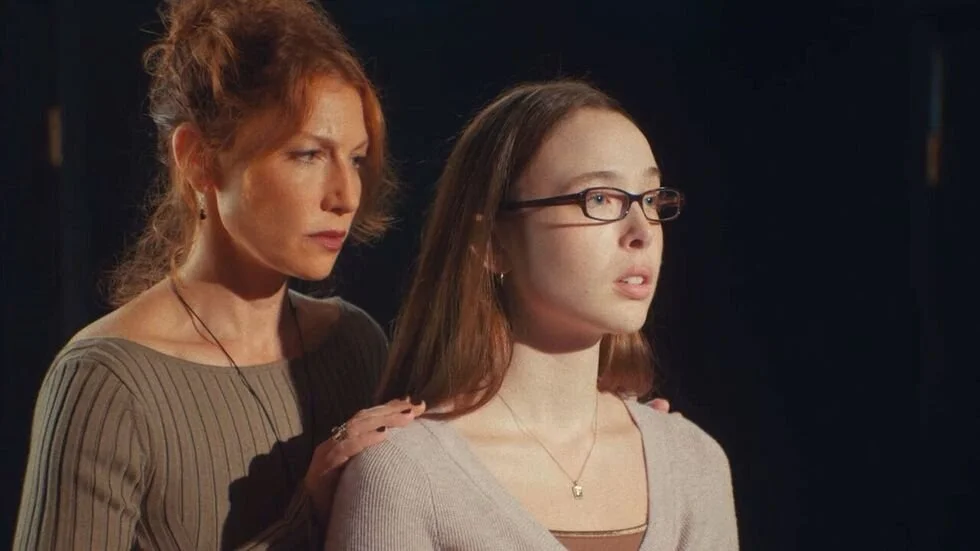
Ari Graynor and Ella Beatty in “Act One”
While Hannah is who the audience sees the world through, you can’t help but notice the structures around her as well. You see the way her earnestness can be both nurtured and exploited. You see how the class is structured with the women reduced, as many women in the industry are, to “character actress” and “ingenue.” You also witness one character assert control, at times manipulate situations and other people. Not that acting or the arts are the only places you find these sorts of dynamics. But, Hannah reflects the best of actors. The people who understand that their job is to express the most human experiences and emotions. And to feel so deeply, some may take advantage of that vulnerability and innate empathy. Certainly, it is not the central focus of the film, but it does exude an air of dread as you witness Hannah navigating these complicated dynamics.
“Act One” also leans into the erotic thriller vein of the 1980s and 1990s. With its complex relationships paired with a young woman coming into her own sexuality, I couldn’t help but think about Roger Kumble’s 1999 “Cruel Intentions,” which was an important film personally during my formative years. Much like “Cruel Intentions” or “Wild Things,” “Act One” always has you second guessing who is in control, or even, who thinks they have the most control. But, unlike these films, what Takal manages to accomplish is this exploration through the lens of a teenage girl. The film is squarely focused on her experience, her understanding, and most importantly her growth. I also cannot overstate how brilliantly Beatty takes on Hannah’s full arc. There is a lot of interiority to her performance, and it is in the film’s final moments which highlight how far this character has gone.
Likewise, Graynor is simply magnetic as Melanie. You quickly understand her allure, and the atmosphere she can create. I don’t think I can envision anyone else embodying this bold force the way Graynor does. Her ability to be charming, domineering, nurturing, assertive all at a moment’s notice takes an actor who understands their character inside and out. The cast as a whole is pretty spectacular, and their performances feel quite lived in. Graynor embodies her character in the most exhilarating ways. Beatty has the trickiest task of bringing an interior subversive performance to life, and effortlessly sticks the landing. It is exciting to watch both of these actors in this film.
“Act One” is an audacious rollercoaster, oozing with style. Takal has largely worked in the horror/thriller space, and each time, she finds new ways to elevate the genre. With “Act One,” she has managed to craft a stylish film rich with flawless technicality and excellent performances.
Grade: A+
Double Feature With: “Forbidden Fruits” (2026) dir. Meredith Alloway